Kelp Pots: Ceramics in the Sea (Part 1)
Written by Kit Tymoshuk
This project would not have been possible without funding from the Ocean Action Grant. Future work will be explored through the Eco-Action Accelerator program.
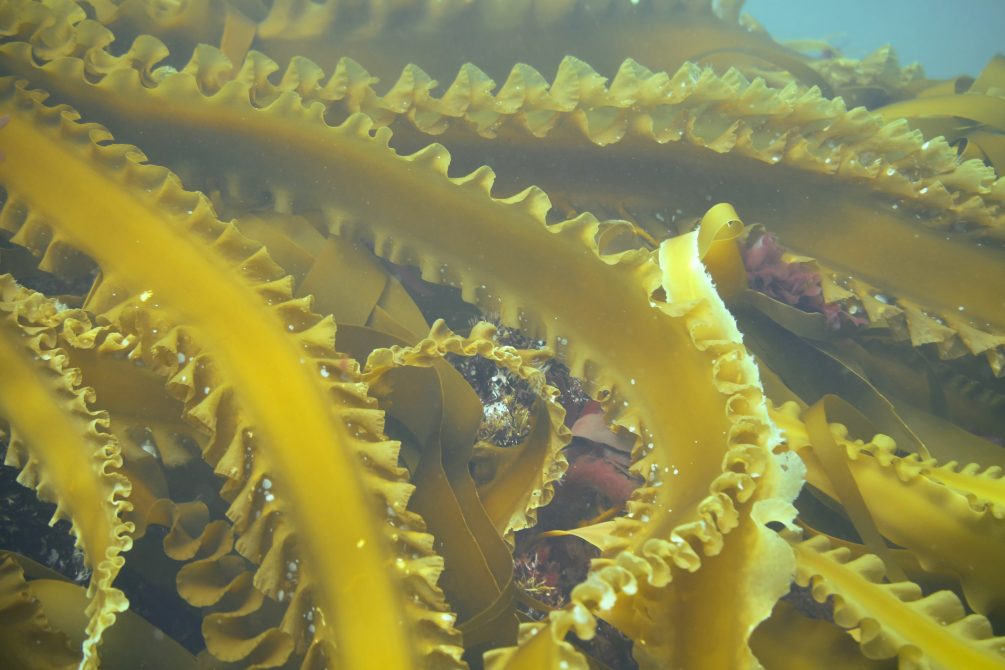
Kelp forests are beautiful and complex ecosystems, providing a multitude of benefits to the ocean. And yet, they are declining worldwide. Increasing water temperatures and marine heatwaves have led to global kelp population loss and decreased resilience to ongoing climate threats. In the ten years I’ve lived in Nova Scotia, the kelp forests have transformed dramatically. Kelp populations in Nova Scotia have declined by 85-99% over the past fifty years, causing many long established kelp beds to become dominated by invasive algae, reducing carbon storage potential and structural habitat availability. As ocean temperatures continue to rise and storm intensity increases in the Northwest Atlantic, the vulnerability of kelp forests throughout Nova Scotia will only continue to grow. So what can be done?
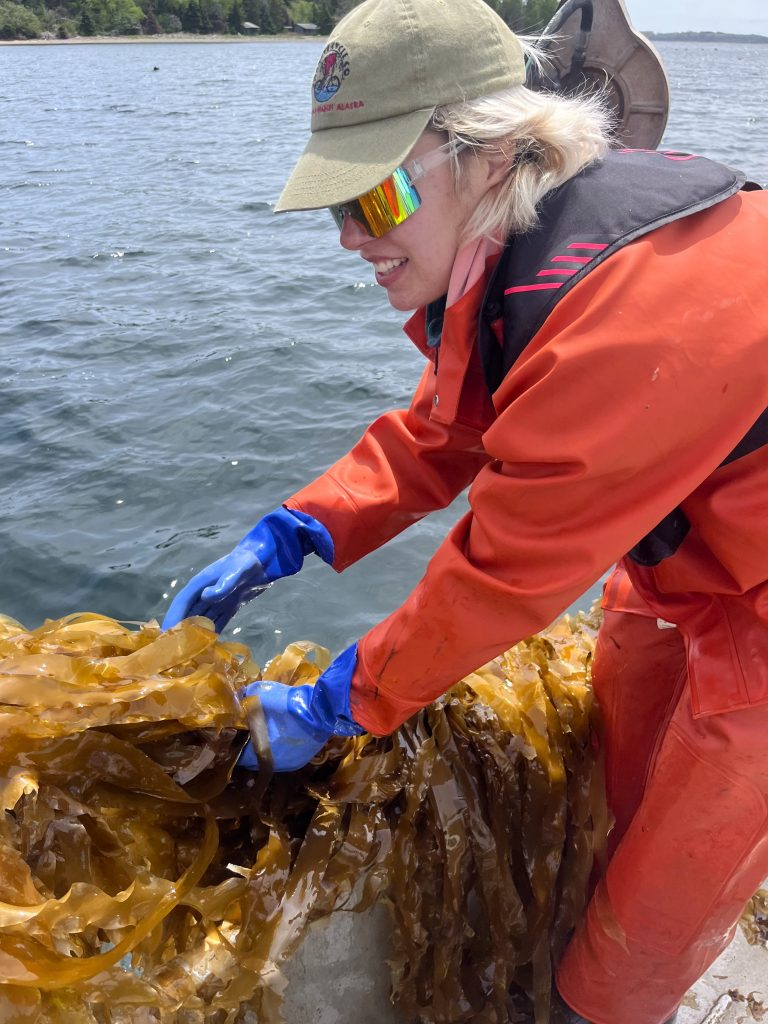
While completing my Master’s in kelp aquaculture over the past two years, I had the opportunity to work alongside incredible scientists and community members doing meaningful work in kelp farming and restoration. The Ecology Action Centre in Halifax has been a pillar of local kelp farming advocacy through their experimental farm in Mahone Bay, raising awareness about the importance of kelp around the province and providing resources for prospective kelp farmers. The National Research Council of Canada is experimenting with green gravel, a process in which sugar kelp is grown on small rocks that can later be deployed across degraded reefs to encourage forest recovery. While my thesis was focused on improving nursery systems for sugar kelp, I became fascinated with the applications of green gravel. If we can grow kelp on rocks, what else can we grow it on?
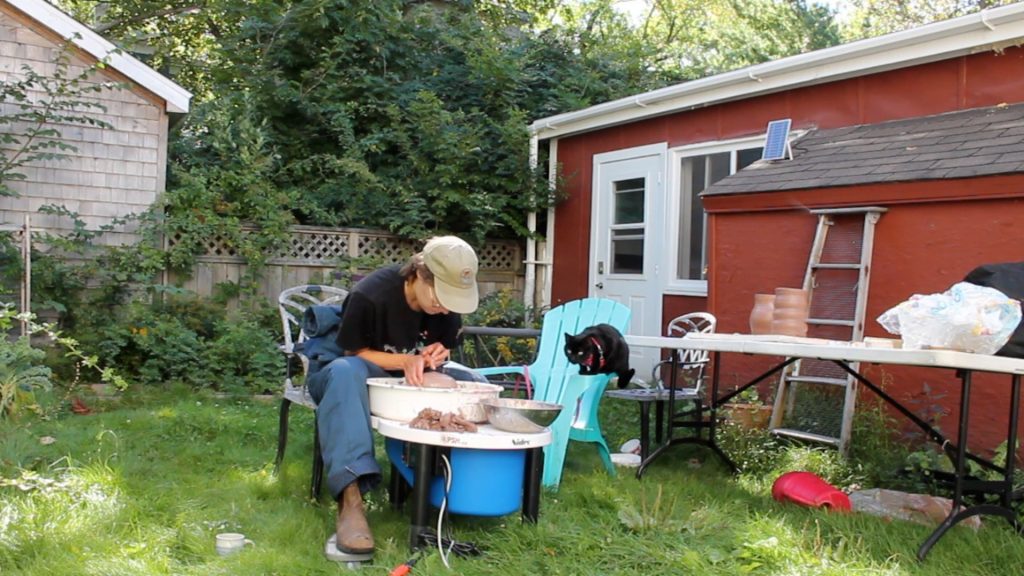
I have been a potter for the past four years. Through my ceramic practice, I’ve become increasingly interested in the relationship between clay and land. We often say that clay holds memory when it resists changes to its shape. The land remembers the past, too; a chronological retelling of billions of years of weathering and sedimentation, telling a clear story about the changes our planet has experienced. At the core of these processes is the concept of regeneration; to bring into renewed existence, to generate again. Clay is formed through the chemical weathering of rocks. With enough heat and pressure it can be transformed into a metamorphic rock, to be transported and broken down into clay again. In the same way, kelp spores settle on a rock in the ocean and a blade of kelp grows. It matures and releases new spores, which disperse and grow more kelp somewhere else.
The goals of this project were to find wild clay deposits in Nova Scotia, create ceramic vessels to grow kelp on, and plant them in a reef where the local forest has been impacted by climate change. Bringing clay and kelp together in this way felt like combining the past, present, and future. Ceramic vessels are often seen as finished objects, but in this project they are part of a changing ecosystem. Through these articles, I will cover everything from the process of gathering wild clay and designing the vessels, to finding a suitable deployment site and growing kelp.
Searching for wild clay
It’s difficult to know where to start when looking for wild clay. It could be anywhere. However, one of the most important rules of foraging is do not do anything illegal, like trespassing on private property. However, because about 26% of Nova Scotia is designated Crown Land, I had 1.5 million hectares of land to explore. Clay deposits are often found where fine particles slowly accumulate over time, like riverbanks, lake beds, bogs, etc. Road cuts, exposed cliffs, and sites of former brickworks can also reveal buried deposits.
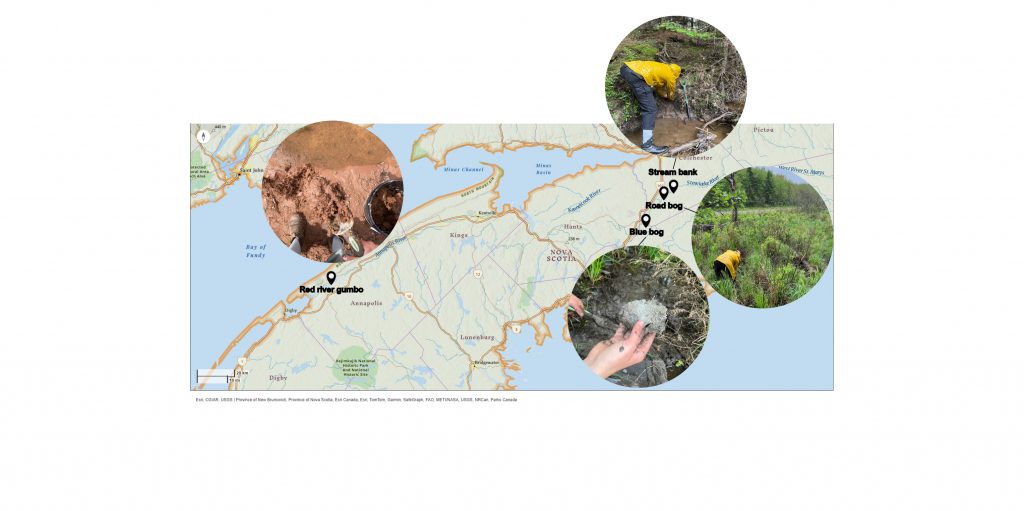
Even so, tramping through the woods could take years to turn up enough usable clay, which is why geological maps became an invaluable tool for this process. Conveniently, in 1980 the Nova Scotia Department of Natural Resources published an online report documenting the locations of various clay and shale deposits around the province. Using this report, I created a list of deposits that were easily accessible and suitable for ceramic use. Over the summer, I visited eight sites, with four yielding promising samples for testing (Figure 4).
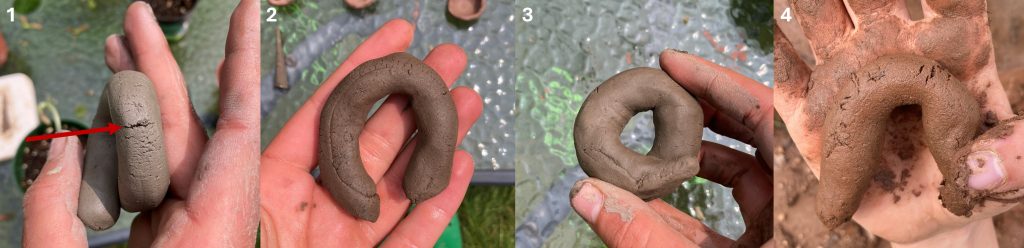
A good clay body for pottery needs to be easy to shape and able to handle firing at high kiln temperatures. A quick workability test is to roll the clay into a worm and coil it into a spiral; if it bends without cracking, it’s likely usable. Three of the four samples passed this test (Figure 5), but I fired them all in a low temperature kiln firing to see how they reacted.
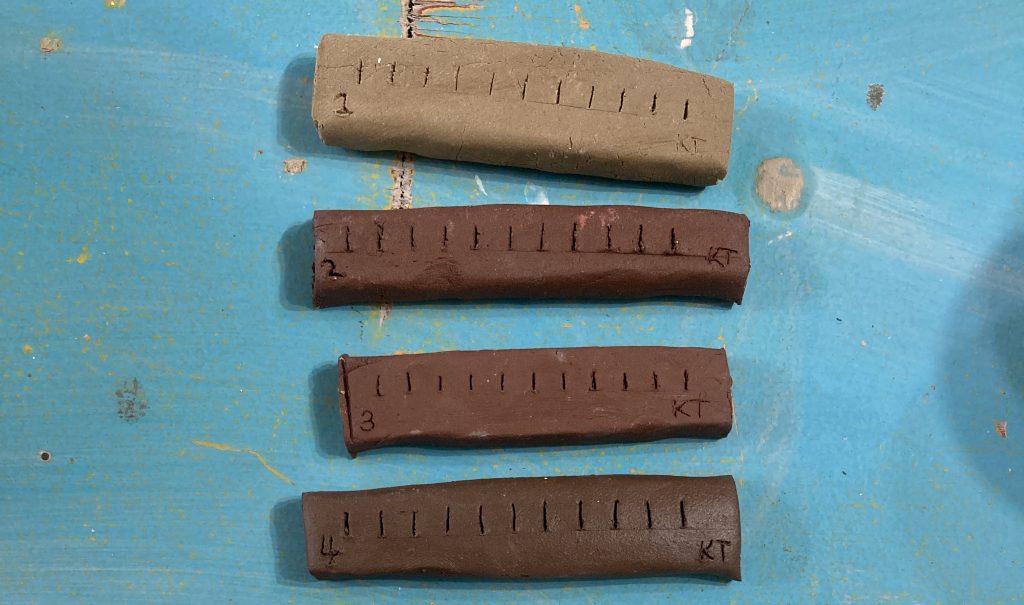
After firing, the red river gumbo clay became shiny and bloated, while the others fired well and became strong (Figure 6). Despite this, I loved the consistency and abundance of the red river gumbo clay, and combined it with the blue bog clay that had an excellent texture once fired. I processed both clays by adding water, sieving out debris, and slowly drying the clays before wedging (mixing) them together with a bit of sand and commercial clay to ensure I had enough workable material.
Vessel design
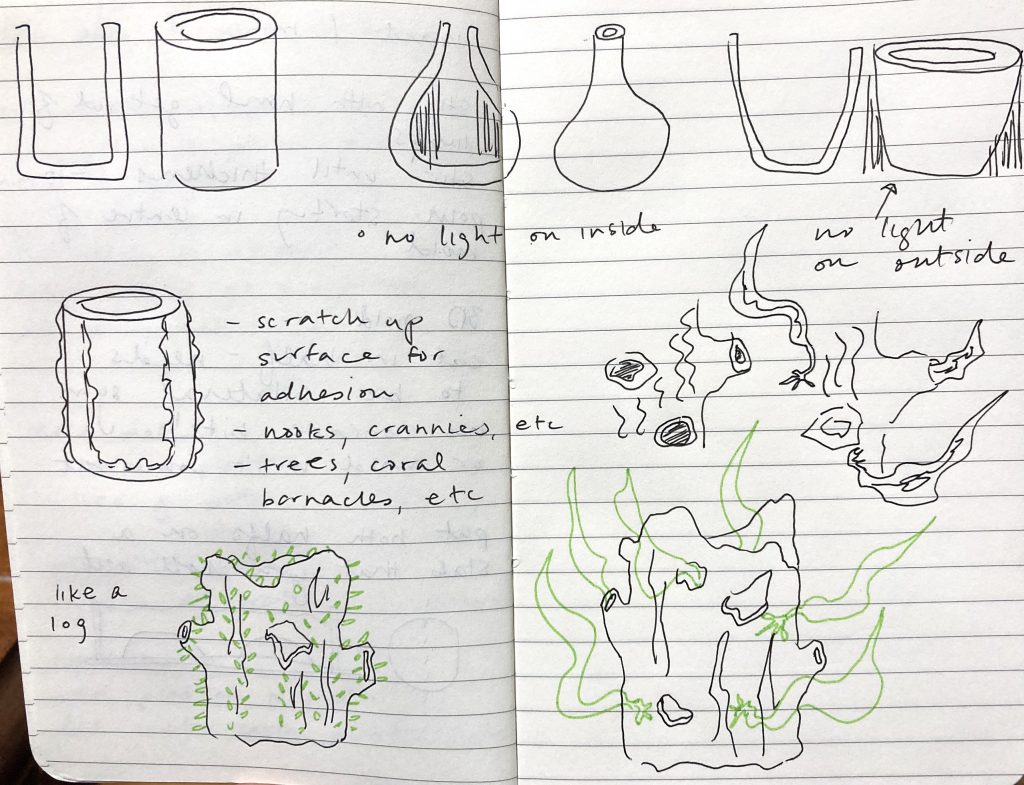
Strength and texture were my key considerations when designing the vessels. They needed thick walls to withstand changing ocean conditions and heavily textured surfaces to encourage kelp spores to settle and attach. They also needed vertical walls to ensure light could reach all sides, maximizing places kelp could grow (Figure 7).
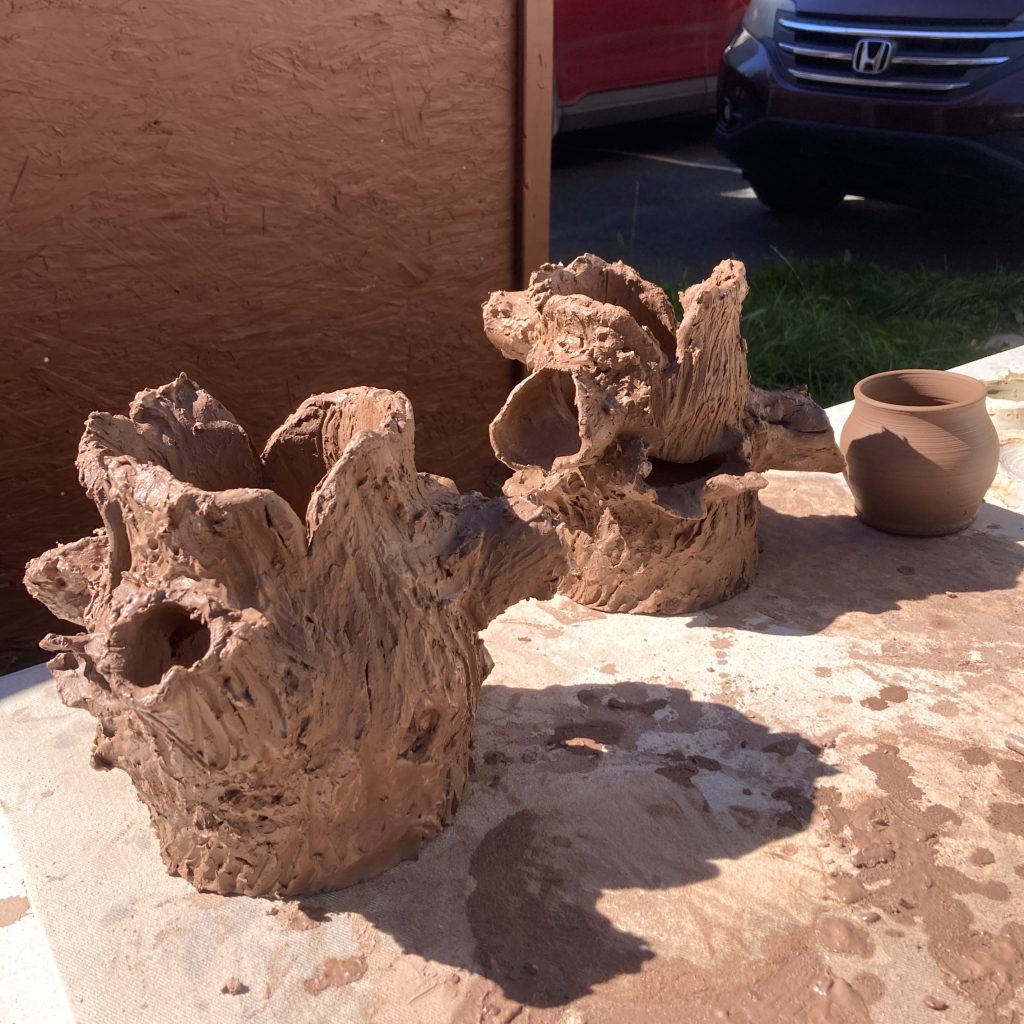
Visually, I wanted to create something reminiscent of a coral reef. It took a few tries to throw shapes I was happy with, but I ended up with large, simple cylindrical shapes. I built up texture on the vessels using my fingernails and tools to scratch and cut at the surface. I added irregular cuts and holes to make them look more natural, and moulded extra pieces of clay on the sides to give the appearance of barnacles. While I initially envisioned reef-like forms, I think the final pieces more closely resemble tree trunks because of their cylindrical shape and red earthy colour. However, I kind of like it. They feel like the trunks of an ocean forest, with the kelp becoming the branches and leaves (Figure 8). Once fired, the vessels were ready for kelp.
“To live in this world
you must be able
to do three things:
to love what is mortal;
to hold it
against your bones knowing
your own life depends on it;
and, when the time comes to let it go,
to let it go.”
“In Blackwater Woods” by Mary Oliver, from American Primitive, 1983.
Posted May 5, 2026 by Kim Bricker