Travail de terrain hivernal – Pas pour les âmes sensibles
« Cet article a été rédigé par Gary Sutton, spécialiste de la recherche à l’Initiative des Baleines d’Ocean Wise. Gary a rejoint l’équipe Ocean Wise en 2021 et apporte près de 20 ans d’expérience avec les baleines en Colombie-Britannique. »
La saison a commencé par des vents réguliers, des pluies froides et beaucoup d’attente. Mais à l’approche de la fin de 2025, les fenêtres météorologiques se sont enfin élargies pour permettre à l’équipe de recherche de terrain d’Ocean Wise de reprendre l’eau et de commencer à collecter des données.
Cet hiver, l’objectif est de sonder la mer Salish et, si nous avons de la chance, de collecter des proies et des échantillons d’ADN environnemental (eADN) sur des épaulards résidents afin de mieux comprendre ce qu’ils mangent en hiver, une saison que nous connaissons bien moins.
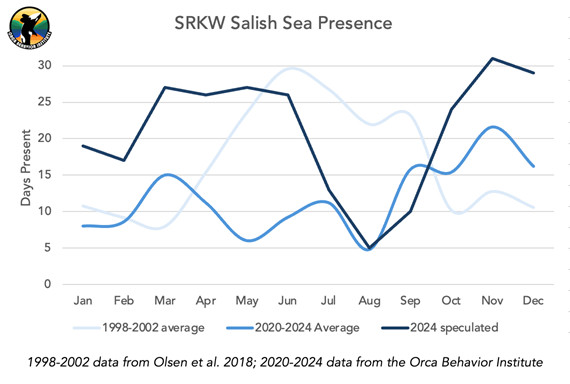
Ce travail s’appuie sur un projet lancé par Ocean Wise en 2023 pour combler les principales lacunes dans les données hivernales identifiées dans les stratégies de rétablissement des baleines en danger dans la région, à savoir les épaulards résidents du Sud en danger et les épaulards résidents du Nord menacés. Historiquement, les habitants du Sud dépendaient fortement de la mer Salish intérieure pendant les mois d’été, suivant les migrations du saumon Chinook vers la rivière Fraser. À mesure que ces stocks de saumons ont diminué, la présence estivale des baleines a également diminué. L’automne et l’hiver s’avèrent désormais être des saisons de plus en plus importantes, les baleines ciblant les saumons hivernaux dans la région.
Prélèvement des proies – Pas une mince affaire
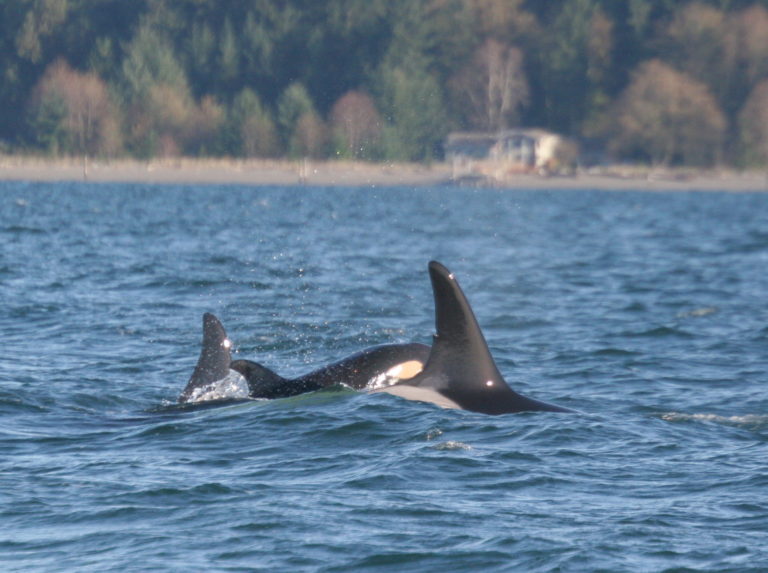
Avec des journées courtes, un temps plus agité et moins de rapports d’observations fiables, trouver les baleines peut être un défi en soi. En hiver, ils sont souvent dispersés à travers le détroit de Géorgie à la recherche de proies. La patience est tout : attendre, scanner et surveiller les changements subtils de comportement qui annoncent une chasse.
Quand une opportunité de nourrir se présente, cela devient une course contre la montre. Le vaisseau doit se rapprocher de l’action, mais suffisamment pour ne pas perturber la poursuite. Une fois que la baleine a sécurisé le poisson, nous pouvons nous approcher prudemment de la zone en espérant trouver ces écailles de saumon scintillantes avant qu’elles ne coulent. Chaque fois que le skimmer de surface propose une balance, une montée d’excitation s’installe à bord. Ces échantillons de proies hivernales sont essentiels pour comprendre quels poissons attirent les baleines dans la mer Salish, contribuant ainsi à orienter les bonnes priorités de conservation.

Suivre les indices dans chaque échelle : ce que mangent les baleines résidentes
Depuis 2023, nous avons collecté 15 proies provenant d’épaulards résidents australes et nordiques. Le groupe A5 résident du Nord, en particulier, visite régulièrement ces eaux du sud en hiver, effectuant de courts trajets vers la Sunshine Coast. Au cours des deux dernières années, nous avons pu profiter de ces visites et recueillir des données précieuses.
La collecte sur le terrain n’est que la première étape. Les échantillons conservés dans l’éthanol sont envoyés à la Station biologique du Pacifique des Pêches et des Océans Canada sur l’île de Vancouver pour analyse via leur laboratoire de sclérotchronologie (vieillissement) et leur laboratoire de génétique moléculaire. À partir d’une seule échelle, les scientifiques peuvent déterminer l’espèce de saumon, l’âge, et même son fleuve d’origine.
Les résultats de 12 des 15 échantillons sont revenus et, sans surprise, les saumons Chinook composaient tous les échantillons sauf un (l’exception était un saumon arc-en-ciel capturé par un épaulard résident du Sud appelé J47). La plupart des poissons avaient entre 3 et 5 ans et provenaient des rivières du sud du Puget Sound, de l’île de Vancouver et de la Colombie-Britannique continentale. Environ un tiers des poissons étaient d’origine d’écloseries, tandis que les deux tiers étaient sauvages. Fait intéressant, un échantillon d’un résident du Nord et un autre d’un résident du sud proviennent du même peuplement, ce qui suggère un chevauchement partiel de l’utilisation des proies en hiver.
En plus des échantillons de proies, nous avons également collecté des échantillons d’ADN électronique appariés pour tester si des événements de prédation peuvent être détectés sans échantillon physique. Ces données sont traitées en interne au laboratoire d’eDNA Ocean Wise et contribuent à un ensemble de données croissant soutenant l’eADN comme outil de recherche peu invasif.
Alors que nous avançons dans les mois d’hiver 2026, vous nous trouverez à bord de notre petit navire de recherche Skana, emmitouflés et scrutant à la recherche de baleines, ainsi que des restes de nourriture qu’elles laissent derrière eux. La saison a commencé difficilement, mais les conditions se sont améliorées, et nous avons déjà obtenu notre premier échantillon de proies résidentes du Sud de l’année.
Le travail de terrain peut être lent, humide, froid et imprévisible. Mais quand une seule balance scintillante atterrit dans le filet, tout cela en vaut la peine.

Posted February 6, 2026 by Nic Schulz