Behind Every Ocean Wise Salmon Recommendation Is a Conversation Worth Having
Whether you’re at the grocery store deciding what to cook for dinner or ordering salmon at your favourite restaurant, you shouldn’t need a background in fisheries science to make a sustainable choice. That’s what we’re here for!
There isn’t a simple answer when it comes to B.C. salmon
Pacific salmon are woven into the ecological, cultural, and economic fabric of British Columbia. They feed ecosystems, sustain coastal and Indigenous communities, support commercial and recreational fisheries, and connect people to place in a way few other species do.
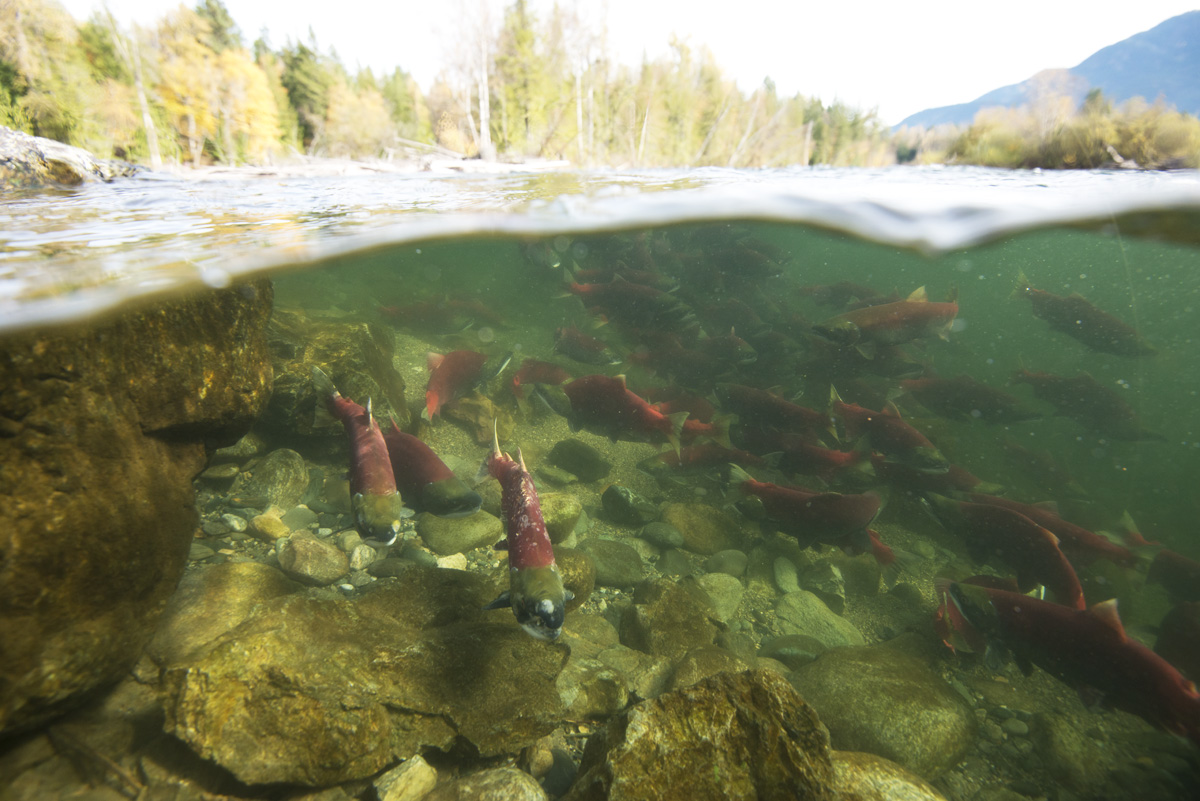
But what makes salmon so remarkable is also what makes them a hard seafood to assess. Throughout their lifecycles, Pacific salmon embark on quite a journey. They’re born in freshwater but live most of their lives in the open ocean. When it’s time to spawn, they make the arduous trek back to their home rivers, even changing their body shape and colour along the way.
How many of them make it back can look completely different from one year to the next. Ocean conditions, prey availability, warming waters, and management decisions (among many other factors!) all shape returns, so a population that comes back strong one season can return sharply reduced the next. That kind of year-over-year swing sits awkwardly alongside conventional sustainability reviews, which tend to be built around multi-year assessment cycles and assume a fishery looks much the same from one year to the next. With more than 100 commercial fisheries targeting B.C. salmon, no single dataset captures the whole picture.
It’s why we revisit our B.C. salmon recommendations every year. Salmon populations shift, and so do the fisheries that depend on them. An annual cycle lets us consider new information and keep our recommendations tied to the best and most current data.
Building a table where expertise meets experience
Before any B.C. salmon rating becomes an Ocean Wise recommendation, it passes through the Salmon Advisory Panel (SAP). We created the panel for a specific reason: to make sure all assessments for B.C. salmon involve a critical evaluation from salmon experts who understand the complexities of the species and current status of the fisheries intimately. The panel brings together experts on B.C. salmon including fisheries scientists and academic researchers, watershed and stewardship organizations, salmon conservation groups, and Indigenous-led seafood organizations.
Dave Moore, SAP Member, Authentic Indigenous Seafoods: “I’m impressed by how unique local insights brought to the SAP can shed new perspectives on how fisheries are adapting and applying best practices”
Every year the rating process starts with our Rapid Assessment Standard (RAPSTA): a science-based method that pulls together publicly available information on a fishery’s target stock health, bycatch, management, and habitat and ecosystem impacts. RAPSTA gives us a precautionary, consistent starting point, drawing from datasets like Oceana Canada’s Fishery Audit, the Pacific Salmon Foundation’s Salmon Explorer, and Monterey Bay Aquarium’s Seafood Watch Salmonid Standard. Then the panel takes it from there!
It’s natural to picture scientific recommendations being made quietly, in a room where everyone nods along. But some of our most impactful conversations happen when members respectfully push back; questioning generalizations, flagging something they’ve seen on the water that the data misses, or bringing regional context and management updates into the conversation. These discussions can get passionate, especially when the subject is as complex as B.C. salmon. But a spirited debate is often a sign the right questions are being asked as everyone works towards the shared goal of making it easier for you to identify sustainable B.C. salmon options!
Dr. Scott Hinch, SAP Member, University of British Columbia: “I don’t think people understand how significantly and fundamentally commercial salmon fisheries have changed in BC in the last 25 years. In the 90’s, exploitation rates in excess of 70% were common. These days, with the changing policy landscape, enroute mortality concerns, and increased weak stock management issues, exploitation rates are much lower.
Part of a bigger vision for sustainable fisheries
Small-scale fisheries are responsible for an estimated 40% of the global seafood catch and are the backbone of many coastal communities around the world. Yet they remain drastically underrepresented in many sustainability programs, in part because of the cost and data requirements to complete traditional sustainability assessments. These assessments also often exclude Traditional Ecological Knowledge and the place-based expertise essential for understanding how these fisheries operate.
While not all small-scale fisheries are inherently sustainable, many have a deep and immediate stake in protecting the waters they depend on. Their vessels, gear and fishing practices can limit where and how they fish, meaning that the health of their local ecosystems is directly tied to the long-term survival of their fishery and the communities that depend on it.
By combining RAPSTA with the place-based expertise of the Salmon Advisory Panel, we have created a more accessible pathway for B.C. salmon fisheries to participate in our sustainable seafood program, while recognizing the unique knowledge, context and realities of each fishery.
We are working to build on this approach and explore how it can be replicated and scaled through our ongoing small-scale fisheries work. Learn more about this work here.
Our small-scale fisheries work is funded in part by the Government of Canada’s Sustainable Development Goals Funding Program.
Posted September 28, 2026 by Kim Bricker