Drones reveal hidden differences in how fish-eating killer whales cooperate
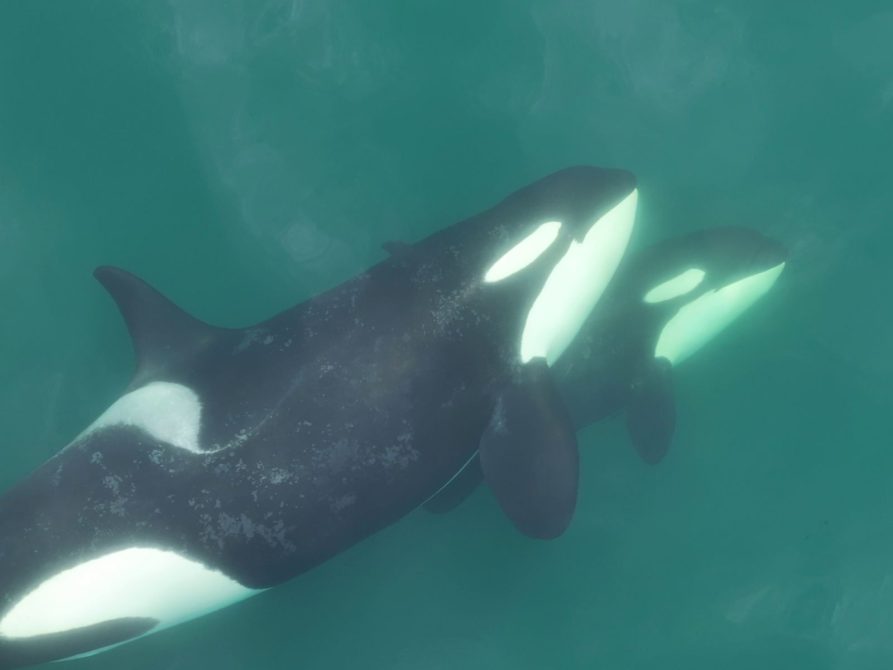
When resources become scarce, cooperation can be put to the test. A new open access study published in Marine Mammal Science examined how two closely related killer whale populations share their salmon prey and found notable differences that may reflect different ecological challenges they face.
Researchers from the University of Victoria, Raincoast Conservation Foundation, Ocean Wise, Center for Whale Research, University of Exeter, NOAA Fisheries, and SR3 used a decade of drone-collected imagery to investigate prey sharing in endangered Southern Resident killer whales and threatened Northern Resident killer whales in coastal Washington State, USA and British Columbia, Canada.
The team examined patterns of cooperation during prey sharing and asked whether the two closely related populations living under different ecological conditions share food differently. While both populations primarily feed on salmon and rely on complex social relationships to acquire food, their recent population trajectories have diverged. The Northern Residents have grown steadily in recent decades and now number approximately 370 individuals. In contrast, the Southern Resident population remains critically endangered, with just 74 individuals, and continues to face a high risk of extinction due to reduced prey availability and other ongoing threats.
Using drones to identify individual whales and document prey-sharing events that are difficult to observe from boats, researchers compared how often whales shared prey, how much prey was shared, who shared what with whom. This bird’s-eye view allowed the team to track the whales and their prey below the water’s surface, often documenting subtle behaviours that may have otherwise gone unnoticed.
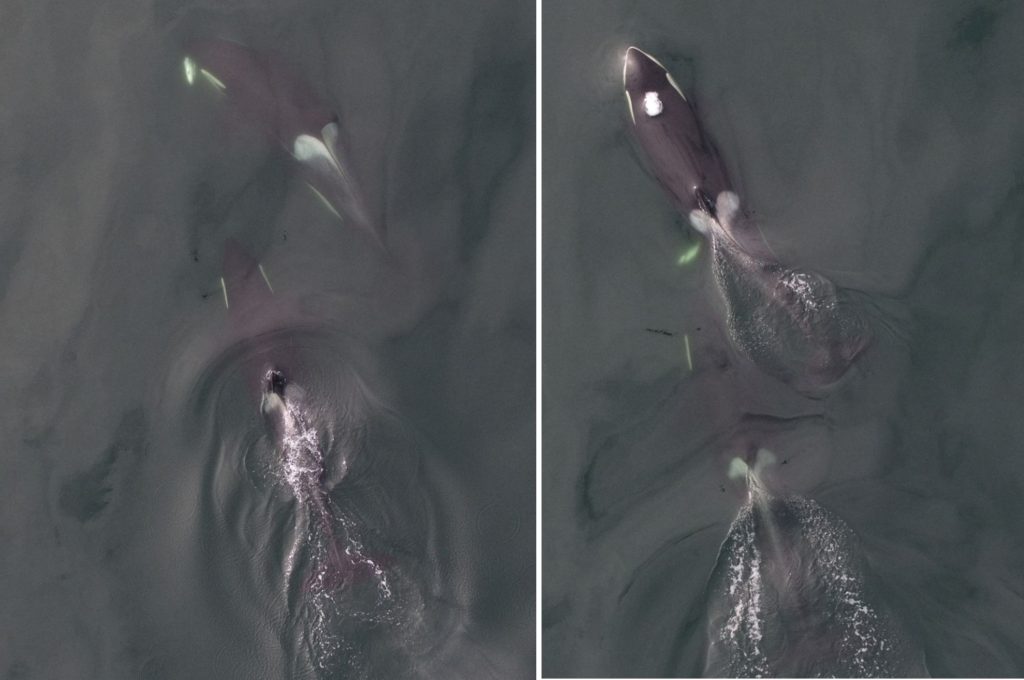
“What struck me about this work is how much was hidden in plain sight,” says co-author Dr. Valeria Vergara, Senior Scientist and Director of Raincoast’s Cetacean Conservation Research Program. “Drones allowed us to document fleeting, subtle interactions, like a whale slowly releasing a small piece of salmon to another slipping in to receive it, that would simply be invisible from a boat. These are the kinds of behaviours that reveal how killer whale societies actually function, and they remind us that there is still so much to learn about the social lives of these animals.”
The study found that Northern Resident killer whales appeared to share prey more frequently than Southern Residents and typically shared larger portions. Adult females in both populations were the primary sharers, most often providing prey to their offspring. However, Southern Resident females tended to share prey less frequently than their Northern Resident counterparts. Researchers also found that Southern Residents were more likely to share outside their immediate family groups.
“These findings suggest that Southern Residents are engaging in cooperative sharing less than Northern Residents, and when they do share prey, Southern Residents share small portions and are less likely to restrict sharing to close relatives,” says lead author Sharon Kay. The results also suggest that prey sharing patterns may shift when food becomes limited. “A pattern potentially evident in the endangered Southern Residents,” adds Sharon Kay. Although the results are preliminary, they provide new insight into how cooperation and food distribution may be influenced when prey becomes less predictable or less abundant.
“This study further highlights the strong social bonds among Resident killer whales that underpin successful provisioning of individuals,” says co-author Brittany Visona-Kelly, Senior Manager, Whales at Ocean Wise. “Despite a more optimistic population trajectory compared to their southern counterparts, Northern Resident killer whales are often overlooked in local protection initiatives. However, changes in prey availability may lead to shifts in prey-sharing behaviour, including reductions in the amount of prey being shared.”
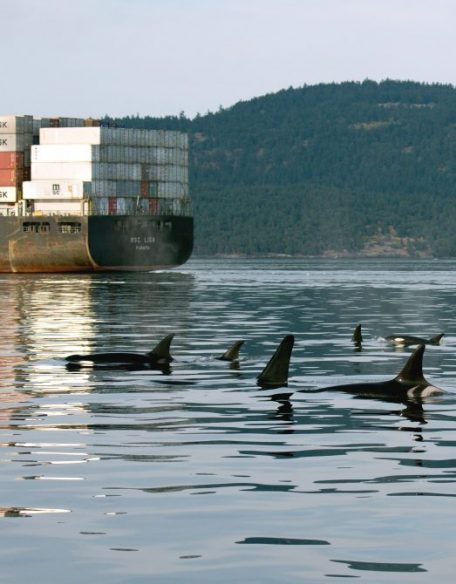
As vessel traffic continues to increase and the oceans become noisier, finding and sharing a limited food source will likely become increasingly difficult for both at-risk populations. Given the important role killer whale females play as provisioners for their families, any loss of individuals could lead to population-wide effects.
“One of the most extraordinary things about the Resident killer whales of the Northeast Pacific Ocean is that after more than fifty years of research, we are still making discoveries about the fundamental nature of their social lives,” said co-author Dr Darren Croft, Executive Director at the Center for Whale Research and Professor of Animal Behaviour at the University of Exeter. “Yet at the same time, we risk losing the critically endangered southern resident killer whales forever. We must act now to restore the abundant Chinook salmon these whales depend on. Without enough food, we risk losing one of the most remarkable animal societies on Earth.”
Citation
Kay, S. W. C., Barrett-Lennard, L. G., Visona-Kelly, B. C., Mikus, M. A., Weiss, M. N., Croft, D. P., Vergara, V., Fearnbach, H., Durban, J. W., Darimont, C. T. 2026. Using Drone-Derived Imagery to Describe Prey Sharing Behaviors in Two Piscivorous Resident Killer Whale Populations. Marine Mammal Science, 2026; 0:e70215 https://doi.org/10.1111/mms.70215
Press contacts
Sharon Kay
236-788-2308
Michael Weiss
Natalie Taylor
Brittany Visona-Kelly
604-659-3848
Authors
Sharon W. C. Kay1,2, Lance G. Barrett-Lennard2, Brittany C. Visona-Kelly3, Marie-Ana Mikus2, Michael N. Weiss4, Darren P. Croft4,5, Valeria Vergara2, Holly Fearnbach6, John W. Durban7, Chris T. Darimont1,2
Affiliations
- Department of Geography, University of Victoria, Victoria, British Columbia, Canada
- Raincoast Conservation Foundation, Sidney, British Columbia, Canada
- Ocean Wise, Vancouver, British Columbia, Canada
- Center for Whale Research, Friday Harbour, Washington State
- Centre for Research in Animal Behaviour, Faculty of Health and Life Sciences, University of Exeter, Exeter, UK
- SR3, SeaLife Response, Rehabilitation and Research, Des Moines, Washington State.
- Anderson Cabot Center for Ocean Life, New England Aquarium, Boston, Massachusetts.



Posted July 24, 2026 by Kim Bricker
Ways you can help

Related articles